
In July 2026, Toyota announced plans to launch an all-electric version of the 13th-generation Corolla—a model that has sold over 57 million units globally since its debut in 1966. Once the undisputed heavyweight of internal combustion vehicles, Toyota had previously vowed never to produce a fully electric model; this sudden reversal stems not from a technological breakthrough, but rather from a reluctant concession forced by circumstance.
For years, Toyota dismissed battery electric vehicle (BEV) technology as unreliable, insisting instead on hybrids and hydrogen power. Having spent over two decades developing its THS hybrid system—amassing patents and driving down costs—the company was confident in its strategy and invested heavily in hydrogen, believing it to be the future. However, its BEV offerings, such as the bZ4X and bZ3, performed poorly in the Chinese and North American markets. Issues ranging from overstated range figures and wheel hub cracking to sluggish infotainment systems led to customer returns and sales figures that lagged far behind competitors.
The Chinese market is evolving rapidly, and Toyota has struggled to keep pace. In the 2025 rankings for top-selling compact sedans, BYD’s Qin Plus, Dolphin, and Wuling Bingo claimed seven of the top ten spots, pushing the Corolla out of the top five. Meanwhile, Tesla slashed prices for the Model 3 and Model Y to below 150,000 yuan, impacting even Toyota’s mid-to-high-end models like the Avalon and Levin. Leveraging its proprietary “Blade Battery,” in-house electronic control systems, and a vertically integrated supply chain, BYD managed to cut EV production costs to roughly 70% of those for internal combustion vehicles. Consumers today are less swayed by the traditional “Japanese reliability” narrative, focusing instead on fast-charging capabilities, upgradable infotainment systems, and responsive voice controls. By 2024, Toyota’s share of China’s new energy vehicle market had dropped to less than 3%—its lowest level in over three decades.
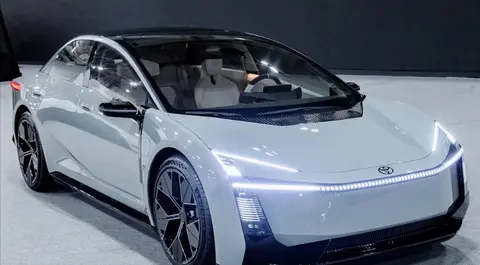
Image source: Internet
To survive, Toyota is making changes; starting in 2025, the company will launch a new system called “ONE R&D.” This initiative allows Chinese engineers to independently propose solutions for the first time. The 13th-generation all-electric Corolla is being developed primarily at the Guangxi facility, utilizing CATL batteries and Desay SV technology for its intelligent driving system. The in-vehicle infotainment system is expected to run on Huawei’s HarmonyOS platform. The new vehicle supports 4D high-precision mapping, multi-screen interaction, and vehicle-to-infrastructure (V2I) connectivity—with the entire technical standard originating from China. This goes beyond simple collaboration; it effectively amounts to an admission by Toyota that it cannot produce a superior cockpit system on its own and must rely on Chinese technology.
While intelligent automotive systems were previously dominated by Tesla and Mercedes-Benz, the HarmonyOS cockpit now enables seamless switching between smartphones, vehicles, and home appliances. Its voice response time is a mere 10 milliseconds—outpacing BMW and Audi—and its NOA (Navigate on Autopilot) system covers 92% of road segments in China’s complex traffic environment, whereas similar features from European manufacturers manage only 68%. Toyota’s decision to adopt HarmonyOS is not merely a purchase of technology but an acceptance of rules set by China; it is rare for a foreign automaker to make a Chinese solution a core selling point.
Toyota has also announced plans to launch all-solid-state batteries with a target range of 1,500 kilometers. While this figure is appealing, the technology has not yet entered mass production; in laboratory settings, it supports a maximum of only 200 charge-discharge cycles. Reports from the Toyota-Panasonic joint venture in March indicated a solid-state battery yield rate of less than 15%. In contrast, the BYD Seal DM-i—utilizing CTB (Cell-to-Body) technology and Blade Batteries—achieves a real-world range exceeding 700 kilometers while reducing costs by 40%. Consequently, the 1,500-kilometer target appears more like a slogan intended to stabilize market confidence; actual commercial sales will still rely on Chinese-made batteries and intelligent driving systems. After reviewing Toyota’s financial reports from recent years, I noticed that their profits in the Chinese market have plummeted much faster than anticipated. There was a time when the Corolla alone could sustain their entire regional operation; now, even after-sales parts are being replaced with domestically produced alternatives. This isn’t a case of their technology falling behind, but rather of them missing a beat in the market’s rhythm. Once consumers have grown accustomed to charging their cars just once a week and having voice commands respond instantly, they are no longer interested in hearing about a car’s ability to last for a decade.
An engineer at their Guangxi facility put it bluntly: “We aren’t just helping Toyota build cars; we’re teaching them how to sell cars in China.” It’s a stinging remark, but largely true.
