
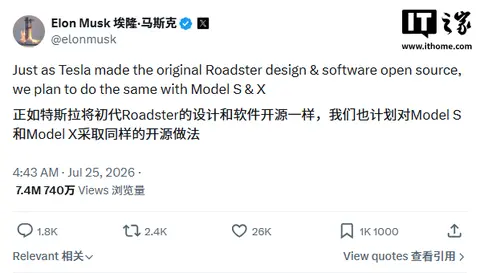
IT Home, July 26 — Tesla CEO Elon Musk recently announced that the company plans to fully open-source the designs and software for the Model S and Model X.
As early as November 2023, Tesla adopted a similar approach with its first model, the Roadster, by making all available design, engineering, and diagnostic data public and stating: “Everything we have, you now have too.”
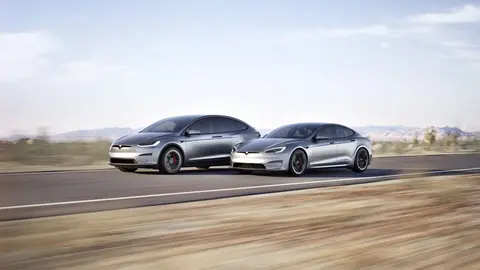
Launched in 2012, the Model S was Tesla’s first mass-produced vehicle and a landmark luxury all-electric sedan. With its impressive range, rapid acceleration, and software system supporting Over-the-Air (OTA) updates, the Model S transformed public perception of electric vehicles.
The Model X, released in 2015, garnered widespread attention as a high-performance all-electric SUV, distinguished by its signature Falcon Wing doors, spacious interior, and advanced safety features. Serving as Tesla’s flagship models for years, these vehicles helped establish the company as a leader in the electric vehicle industry and drove the adoption of long-range all-electric cars.
Tesla began phasing out production of the Model S and Model X in early 2026, officially ending manufacturing in the second quarter. The Fremont factory production lines previously dedicated to these models have been repurposed for higher-priority projects, such as the Optimus humanoid robot and the Cybercab autonomous taxi.
By the time Musk announced the open-source initiative, the Model S and Model X were no longer accepting custom orders, with only existing inventory available for purchase.
Open-sourcing the designs and software offers numerous benefits. Owners of these models will gain easier access to technical documentation, diagnostic tools, and software resources, enabling them to perform repairs or modifications themselves more easily and cost-effectively.
At the same time, independent repair shops and third-party service providers will gain access to greater technical support—reducing their reliance on Tesla’s official service network—and be better equipped to maintain the large existing fleet of these vehicles.
Furthermore, engineers, developers, and automotive enthusiasts can delve into Tesla’s actual designs for batteries, electric drive systems, and software architecture, potentially driving technological progress across the entire electric vehicle industry.
This move aligns with Tesla’s 2014 patent pledge, reflecting the company’s philosophy of advancing sustainable transportation by sharing years of accumulated technological achievements rather than relying on closed, proprietary technology barriers.
Releasing this information after the models have been discontinued not only provides ongoing support for early adopters but also allows Tesla to allocate more resources to next-generation technology development. The previous open-sourcing of the Roadster, for instance, spawned numerous simulation projects, community-led development initiatives, and in-depth technical studies. This approach has now been extended to the Model S and Model X, where it is expected to yield similar results on a broader scale, ensuring that these two landmark models retain excellent maintainability and enduring technical value for years to come.
